
Last updated November 25, 2026
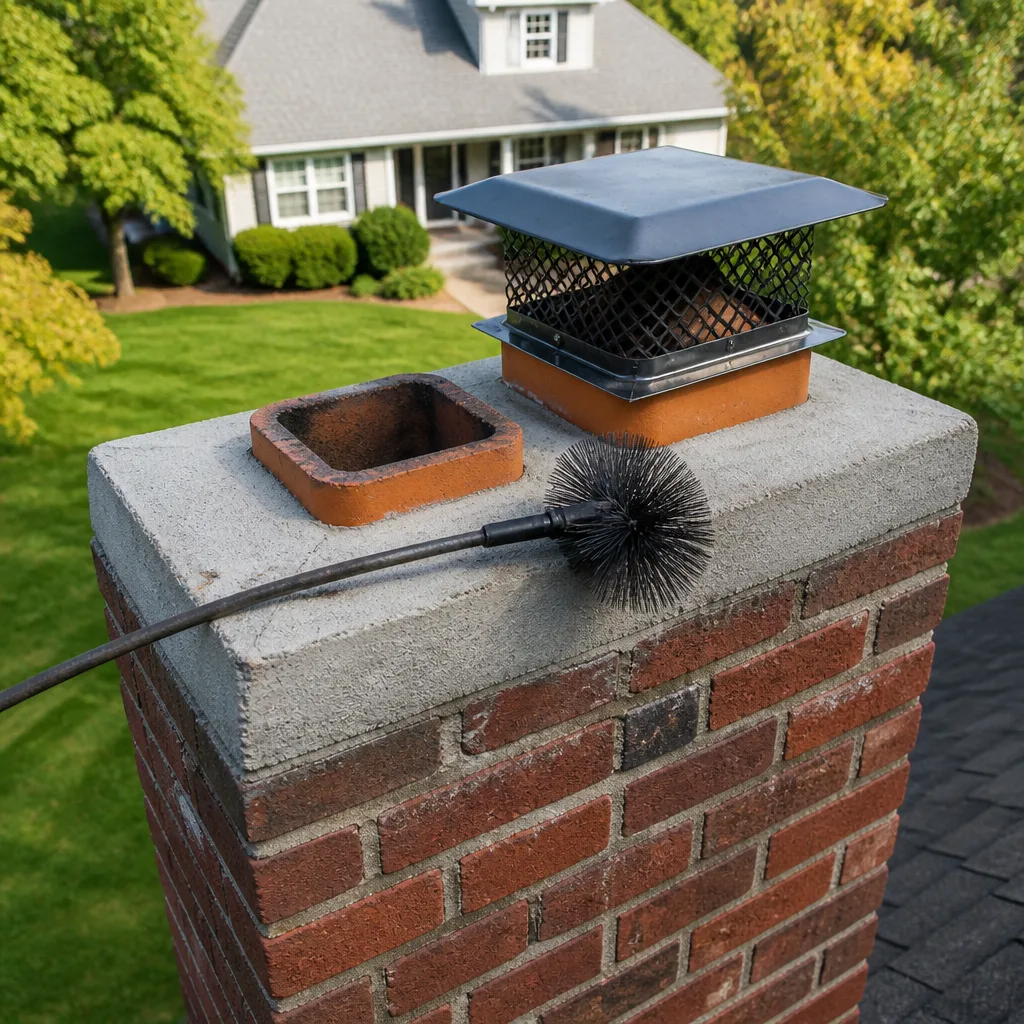 Sweep & inspection
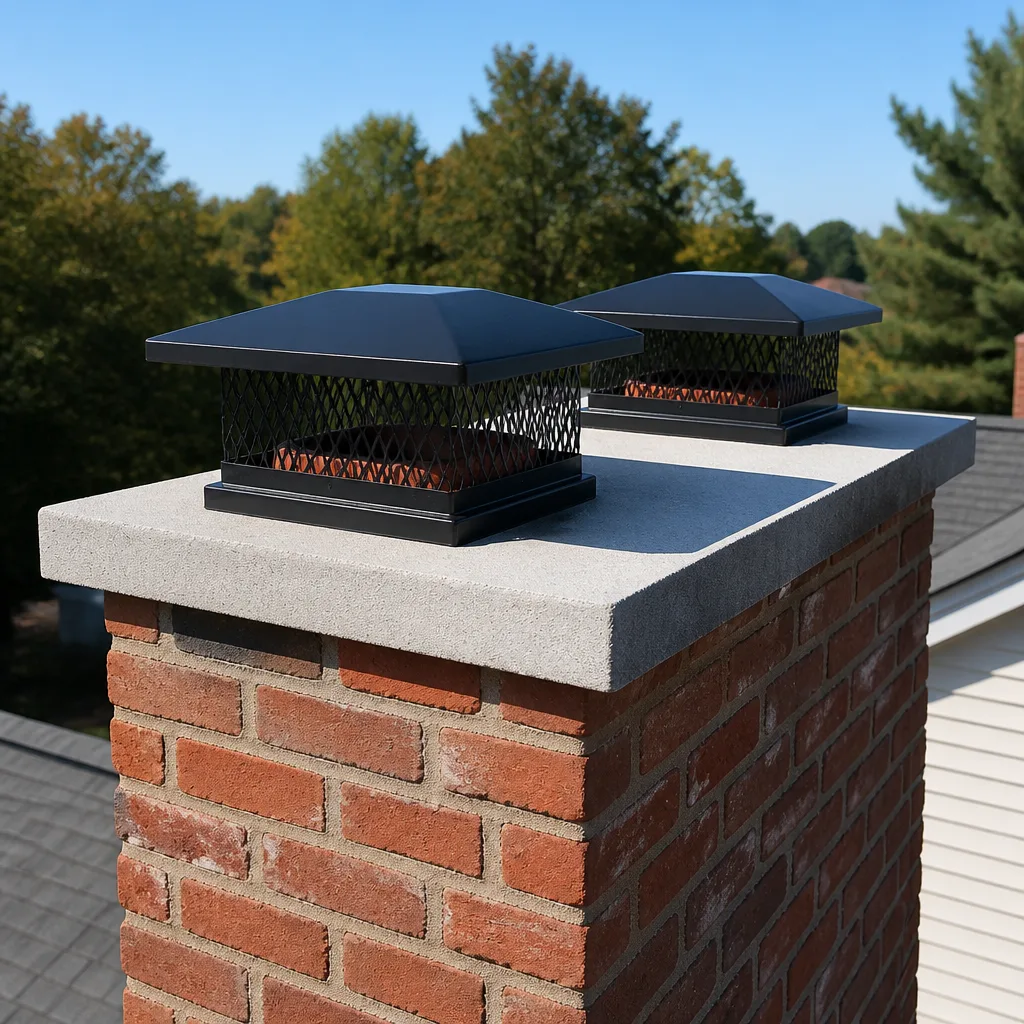 Caps & crowns
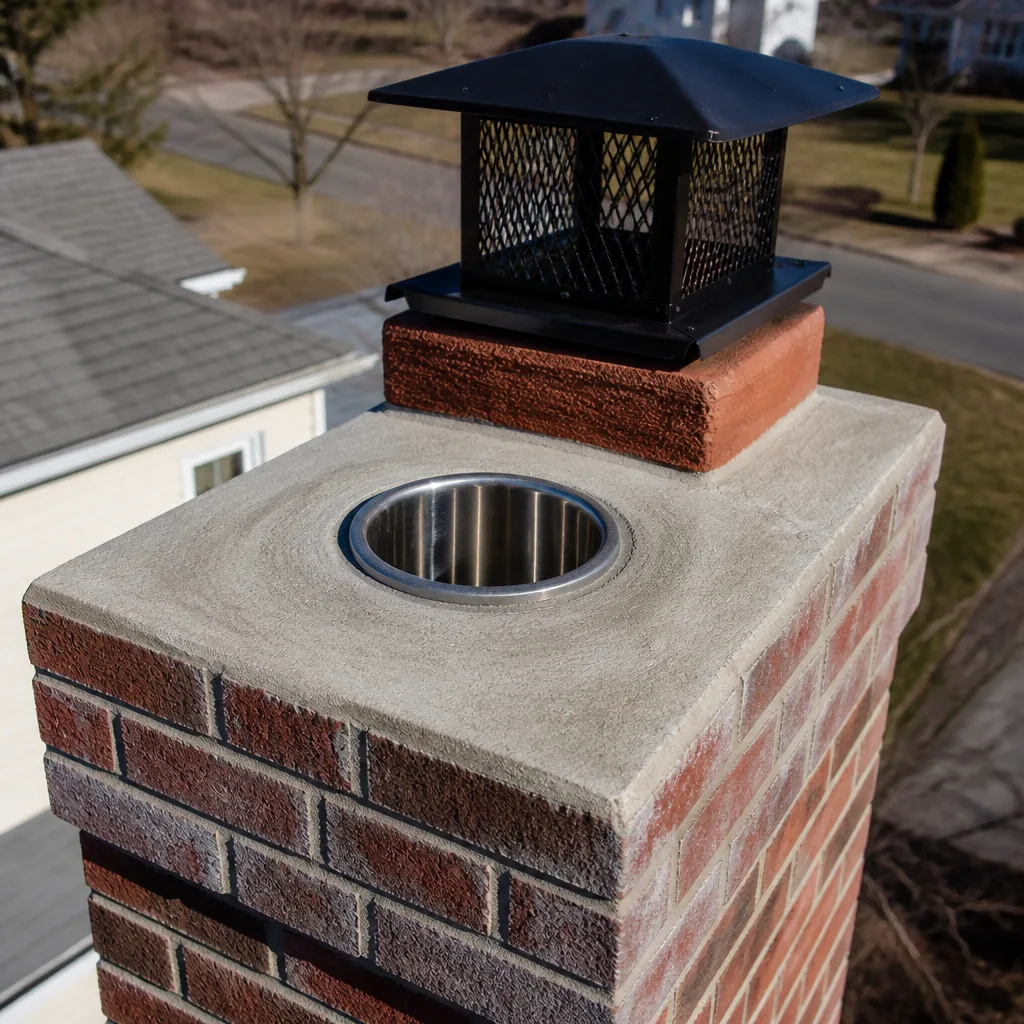 Flue relining
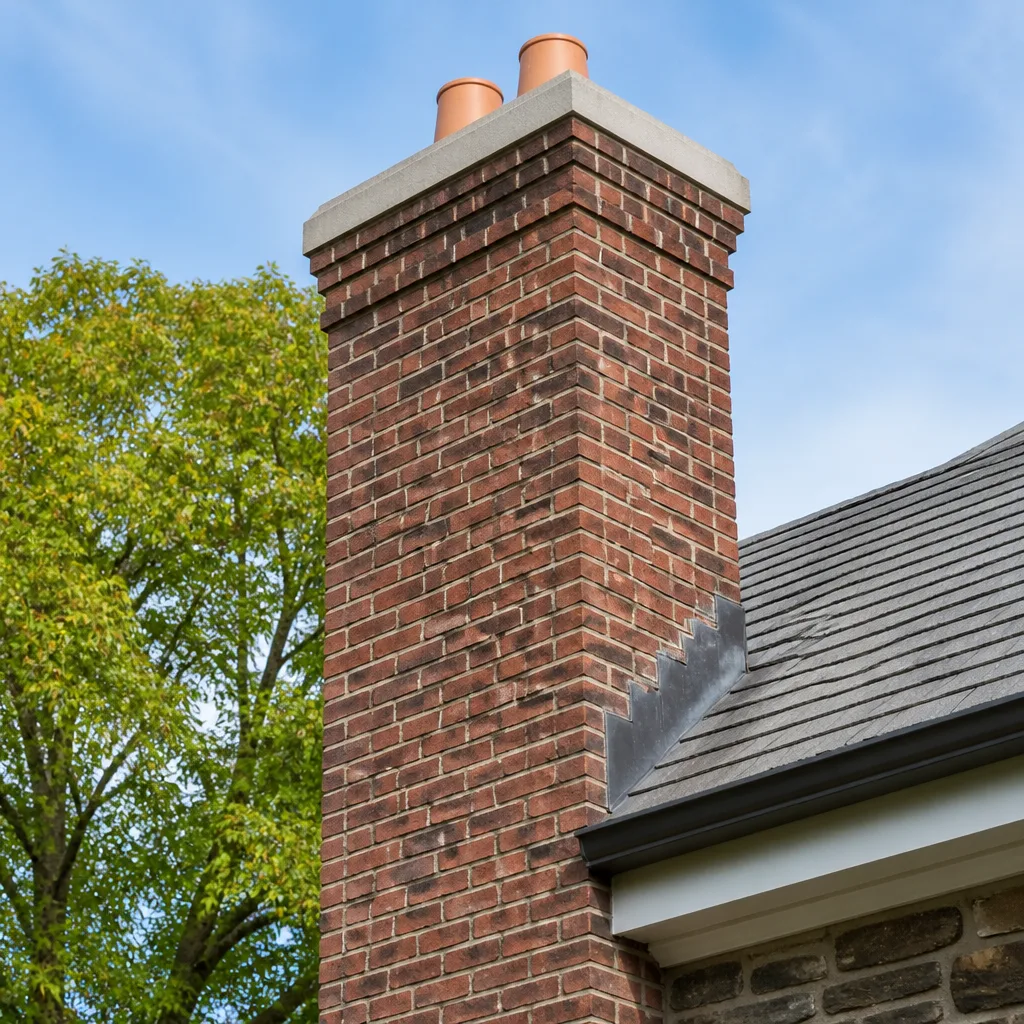 Masonry repair
 Gas fireplace service
Level 1 sweep and inspection to the NFPA 211 annual standard - flue, crown, cap, and flashing checked and photographed
Chimney sweep logs do not sweep chimneys. They loosen some creosote - which then falls where a brush and vacuum still have to collect it.
How to Hire a Chimney Cleaning Contractor in Elmwood Village: A Step-by-Step Guide
A CSIA-certified chimney sweep and a handyman who offers chimney cleaning as an add-on service charge similar prices in Western New York, and they produce vastly different results. That’s the thing most homeowners don’t realize when they start calling around Elmwood Village looking for a sweep. New York State doesn’t license chimney technicians, so there’s no government-issued credential that separates a trained specialist from someone with a brush and a ladder. The vetting falls on you. This guide walks through the specific sequence we’d use ourselves if we were hiring out this work: verifying credentials, asking the questions that reveal scope of capability, reading a written estimate line by line, understanding what insurance actually protects, and getting a scope-of-work document that protects you if repairs get recommended after the cleaning.
Quick Answer
Hiring a chimney cleaning contractor in Elmwood Village means verifying third-party credentials (CSIA, NFI, or NCSG), confirming the company handles full-system work rather than surface-only sweeping, and getting a written estimate that itemizes inspection, sweeping, and a liner camera scan separately. Ask five specific questions before you book, confirm the company carries general liability insurance, and insist on a written scope of work before any technician enters your home. Price is the least reliable way to compare contractors in this market.
Styles & brands we work with
- Sweep & inspection
- Caps & crowns
- Flue relining
- Masonry repair
- Gas fireplace service
Table of Contents
- Why chimney credentials matter more than price
- What CSIA, NFI, and NCSG credentials actually certify
- Five questions to ask before you book
- How to read a chimney cleaning estimate
- Why “insured” isn’t enough
- What a professional scope-of-work document should contain
- Elmwood Village climate, housing, and chimney considerations
- The vetting call: questions to ask at booking
Why chimney credentials matter more than price in Elmwood Village
New York State doesn’t require a license to sweep a chimney. Anyone with a brush and a ladder can legally advertise chimney cleaning in Elmwood Village, and the price they quote will typically land in the same range as a credentialed specialist’s. That’s the part that surprises homeowners. The cheap quote and the thorough quote are often within a hundred dollars of each other, but the thorough quote includes a camera scan of the flue, a written condition report, and a technician who can identify a hairline crack in the liner before it becomes a fire risk.
What credentials do is give you a way to check a technician’s training against an outside standard. When you hire a company carrying a CSIA certification, you’re confirming that the person in your home has passed a national exam on venting, draft, codes, and safety. You’re not just taking a van’s word for it. That matters in a neighborhood full of 1920s and 1930s homes where the chimney is often the original masonry flue, and where a technician has to understand how a century of use and a few decades of deferred maintenance interact.
Elmwood Village has a lot of homes built between 1910 and 1940, many with interior masonry chimneys that vent a fireplace, a furnace, or both. The flues in these homes have usually been relined at some point, sometimes with the original clay tile and sometimes with a later insert’s flexible liner. A brush-only sweep won’t detect whether that liner is still continuous. A credentialed technician will put a camera down the flue and show you what it sees. That’s the difference between a sweep and a chimney service.
Three credentials come up repeatedly in this trade, and they certify different things. Knowing which is which tells you what you’re actually buying.
What CSIA, NFI, and NCSG credentials actually certify
CSIA, NFI, and NCSG are the three credentialing bodies you’ll see on a chimney company’s website or van in Elmwood Village. Each one tests a different body of knowledge, and each one tells you something different about the technician on your roof.
CSIA – Chimney Safety Institute of America
CSIA is the certification most homeowners recognize because it’s the oldest and most widely administered. A CSIA-certified sweep has passed the CSIA National Chimney Sweep Training School exam, which covers the physics of draft, venting fundamentals, national fire codes, chimney construction, and the practical work of sweeping, inspection, and problem diagnosis. The certification has to be renewed, and renewal requires continuing education credits and a demonstrated commitment to the CSIA code of ethics. When you see a CSIA badge, you’re looking at someone who has studied chimney science beyond the trade-school basics and agreed to a professional standard.
NFI – National Fireplace Institute
NFI certification is different. It tests gas, wood, or pellet appliance installation and venting knowledge, and it’s usually held by hearth professionals who install fireplaces, stoves, and inserts. An NFI-certified technician understands how a wood stove or gas fireplace should vent into a chimney, what the clearances should be, and how appliance choice affects draft. It’s not the same body of knowledge as CSIA – it’s appliance-focused rather than chimney-focused – but a technician holding both is a stronger signal than a technician holding one.
NCSG – National Chimney Sweep Guild
NCSG is a professional membership organization rather than a testing body. Its members commit to a code of ethics and a standard of practice, and the guild provides education and industry advocacy. Membership tells you the company has chosen to affiliate with a trade organization that sets expectations. It isn’t a substitute for CSIA or NFI testing, but it’s a useful signal alongside one.
The practical upshot for Elmwood Village homeowners: three credentials verified through public lookup is far more meaningful than a website that says “certified technicians” without naming the certifying body. If a company won’t say who certified them, that’s the answer to your question.
Five questions to ask before you book a chimney sweep in Elmwood Village
These five questions are what separate a full-system chimney specialist from a company doing surface-only cleaning. Ask them on the phone before you commit. Listen for specificity in the answers. A technician who does full-system work will answer each question in detail without hedging.
- “Do you camera-scan the flue as part of the visit, and will you show me the footage?” – A camera scan is what turns a sweep into a diagnostic visit. You want to hear that the scan is standard and that the footage is yours to see. A yes without the follow-through on “show me” is half an answer.
- “Is inspection offered as a standalone service, or only bundled into cleaning?” – Full-system companies offer inspection independently. If a company only inspects as part of a cleaning-and-repair package, ask why. Often it’s because the inspection is being used as a sales tool rather than a health check.
- “Do you perform liner work, crown work, and cap installation in-house, or do you subcontract it?” – The answer should be that the company handles these directly. Handoffs mean someone else sizes your liner and installs your crown, and the diagnosis you received isn’t speaking to the person doing the work.
- “What brands of liner and cap do you install?” – Professional-grade answers include DuraFlex, HeatShield, Gelco, Olympia Chimney, Famco, and Copperfield. These are the material systems certified chimney professionals rely on. If the answer is vague or names generic substitutes, the company is buying product on price rather than performance.
- “Will I receive a written report of what you found, including photographs?” – A written report is the document that lets you make repair decisions over months rather than in a pressured moment on the day. If a company doesn’t write reports, you’re relying on memory of an oral conversation.
We structure our own visits around exactly those five answers, which is why a chimney sweep through us includes a camera scan and a written report rather than just a brush and a broom.
How to read a chimney cleaning estimate in Elmwood Village
A written estimate should itemize inspection, sweeping, and liner camera scan as separate line items before it lists any recommended repair. If those three appear bundled into a single lump sum, you can’t tell what you’re paying for, and you can’t compare one estimate against another. Bundled pricing is the number-one red flag in this category.
Here’s what a professional estimate looks like in structure (not in price, since that’s set per job):
- Inspection – listed separately, with a description of what the inspection covers (Level 1, Level 2, or Level 3, per the industry standard three-level system)
- Sweeping – the cleaning itself, itemized by flue or by appliance, if you have more than one
- Camera scan – the flue video inspection, usually listed as its own line because it’s a distinct diagnostic step
- Findings summary – what the technician found, written in plain language
- Recommended repairs – only after findings, and never presented as automatically urgent without camera evidence
Three bundled-pricing red flags:
- “Cleaning and inspection – one price.” You can’t tell whether the inspection is a quick look or a camera scan.
- “Full service today only.” Repair recommendations should not carry a same-day discount. The urgency should come from the condition of your chimney, not the calendar.
- No written findings. If the only record of the visit is a receipt, there’s no way to track the chimney’s condition over time.
The estimate itself should be free. When you call for a chimney sweep in Elmwood Village, the range should be quoted and the final price confirmed by a written estimate before any work starts. If a company charges for the estimate, that’s a legitimate business choice, but ask what it includes.
One more thing worth knowing: a chimney sweep visit that finds a clean chimney should still produce a written report. A report isn’t a sales document, it’s a maintenance record. Keep them. In twenty years, whoever owns your home will want that history.
Why “insured” isn’t enough for chimney work in Elmwood Village
A company saying “we’re insured” is a start, not an answer. Chimney work involves climbing on roofs, working inside flues, and occasionally resurfacing masonry with specialized compound. Different insurance policies cover different things, and the coverage that matters most for in-home structural work often isn’t the one a homeowner thinks to ask about.
General liability insurance
General liability covers third-party bodily injury and property damage on the job. If a technician drops a tool onto your slate roof or knocks over a lamp, general liability picks up the cost. This is the baseline every reputable chimney company carries. Ask for the certificate of insurance and confirm it names the business you called.
Chimney-specific errors and omissions
Errors and omissions (E&O) coverage is different. It covers mistakes in professional judgment – a liner sized incorrectly, a crown installed at the wrong pitch, a resurfacing job that fails prematurely because the prep was wrong. Standard general liability doesn’t cover this. Chimney-specific E&O is less common in this trade than in professions like law or medicine, but it’s the coverage that matters if a HeatShield resurfacing or a DuraFlex liner installation has to be redone at the company’s expense. Ask whether the company carries E&O and what it covers. Companies doing structural chimney work should have an answer.
Workers’ compensation
If a technician is injured on your property and the company doesn’t carry workers’ comp, the injury can fall on your homeowner’s policy. Workers’ comp in New York isn’t always mandatory for the smallest operations, so confirm coverage directly. A simple “do you carry workers’ compensation, and can you send me a certificate?” is enough.
This isn’t about assuming the worst. It’s about the reality that chimney work is physical, height-involved, and structural. The trades that do it legitimately carry coverage because the work requires it. That coverage is part of what makes the estimate what it is.
What a professional scope-of-work document should contain
A scope-of-work document protects you if follow-up repairs get recommended after cleaning. It’s the piece most homeowners don’t ask for, and it’s the piece that matters most in Elmwood Village, where pre-war housing stock means older chimneys often turn up more than one issue at a time.
The document should contain:
- Technician name and credential – who performed the work, and what credential they hold (CSIA, NFI, or both)
- Date and conditions – the date of the visit, and any relevant observable conditions (weather, appliance status, flue access)
- Flue description – the number of flues, their construction (clay tile, stainless liner, metal chimney), and their approximate dimensions
- Method of cleaning – what brush or tool was used, and whether any obstruction was found
- Camera scan findings – what the video showed, with photographic stills if any damage was noted
- Crown and cap condition – the condition of the crown, the cap, and their fit against the flue, since failures here cause most water intrusion
- Recommendations – any repairs recommended, with the specific area or component identified and a stated time frame for urgency (immediate, monitor, or when convenient)
- Signature and company contact – the technician’s signature, the company name, and a phone number for follow-up
If a technician hands you a handwritten receipt instead of a document with those sections, ask for the full report. Companies doing full-system chimney repair work produce reports because they need them internally to plan the repair. Homeowners just need to know to ask for one.
Elmwood Village climate, housing, and chimney considerations
Elmwood Village sits in Western New York, which means real freezing winters and rapid freeze-thaw cycling from late fall through early spring. That cycle does specific things to a chimney. Water penetrates small cracks in the crown or the mortar during warmer days, then freezes and expands overnight. Each cycle widens the crack a little more. Over years, small cracks become spalling masonry, and spalling masonry becomes a rebuild.
The interwar housing stock in Elmwood Village – many homes built between 1910 and 1940 – works with this climate in two specific ways. First, most of these chimneys are unlined or only partially lined with clay tile, and clay tile degrades fast under freeze-thaw. Second, many have had wood-burning inserts or gas appliances added over the decades, and those appliances vent differently than the original masonry flue was designed to handle. A wood insert often needs a stainless flex liner to draft correctly; a gas appliance needs a correctly sized flue or it deposits corrosive condensation on the liner itself.
Three things to check on a chimney in Elmwood Village specifically:
- Crown condition. The concrete or mortar crown at the top of the chimney should overhang the masonry and shed water. A cracked or improperly pitched crown lets water into the flue wall. Cap and crown chimney cap & crown work addresses this directly and stops most water damage before it reaches the liner.
- Cap fit. A chimney cap sized to the flue prevents rain, snow, and animal entry. A properly sized cap also supports draft performance. A cap that’s too small or too large fails at both jobs. This is where product specification matters – Gelco and Famco cap and venting sizing is one reason we use them.
- Liner continuity. A camera scan is the only way to confirm the flue is continuous from firebox to cap. For clay-tile flues that have been in service for decades, small gaps between tile sections are common and can leak carbon monoxide into the home.
These three checks are what an inspection produces in this specific city. They’re not generic. The climate produces the failures, and the housing stock determines where you’ll find them first.
The vetting call: what to ask when you book
The phone call is where the vetting actually happens. Most homeowners spend it on price and scheduling. Spend ten minutes on the questions below instead, and you’ll learn more about the company than any website or review would tell you.
- “Who will be at my home, and what credential do they hold?” – Ask for the specific credential and the certifying body. You should be able to look up a CSIA certification.
- “What’s included in the visit, specifically?” – You’re listening for sweeping, inspection, and camera scan named separately, plus a written report.
- “How do you handle findings – do you recommend repairs on the same visit?” – A good answer separates diagnosis from recommendation and lets you decide on repairs after you’ve seen the evidence.
- “What would you do if you found a cracked crown but no damage to the liner?” – The answer tells you whether the company can handle crown work as its own line item or only as an upsell.
- “Do you install HeatShield or DuraFlex?” – Both are professional-grade options. HeatShield ceramic resurfacing can restore a flue that might otherwise need full relining. DuraFlex flexible liner systems suit the irregular flue paths common in older construction, which fits Elmwood Village housing stock specifically.
- “Can I see the written report before I agree to any repair?” – If the answer is yes, the company is working in the right direction. If it’s not, you’re looking at a sales visit rather than a service visit.
One last check: ask whether the company offers inspection as a standalone service. A specialist that inspects without cleaning isn’t using inspection as a sales funnel, which means the diagnosis you get from them is more likely to reflect what the chimney actually needs. We offer inspection on its own for exactly this reason.
Common Mistakes to Avoid
- Booking on price alone. The cheapest quote and the thorough quote often land within a narrow band, and the cheaper one usually skips the camera scan and the written report. In Elmwood Village, the difference between a sweep and a full-system visit is not hundreds of dollars – it’s a scan and a document.
- Accepting a verbal report. A verbal report is whatever the technician remembers saying. It’s not a record. Insist on a written one, and keep it with your home records.
- Letting the technician recommend repairs without seeing the evidence. Repairs recommended without camera evidence should not be accepted on the first visit. Ask to see the footage and the photos before you decide.
- Assuming “insured” means covered. General liability, errors and omissions, and workers’ compensation cover different things. Ask which coverage the company carries and request a certificate.
- Waiting for a blockage before calling. Chimney fires and carbon monoxide problems start in the flue, not in the firebox. An annual inspection catches liner damage before it matters. The seasonal urgency in Elmwood Village is real – get the inspection done before burning season, not after.
- Hiring a general handyman for a chimney job. Chimney work is a specific trade with specific tools, specific codes, and specific materials. The handyman who “can take a look” is not the person you want on your roof.
- Skipping the cap and crown check. The cap and crown are the most common water-entry points on a chimney, and they’re the cheapest to fix before water damage reaches the liner. A sweep that skips the crown check isn’t seeing the whole system.
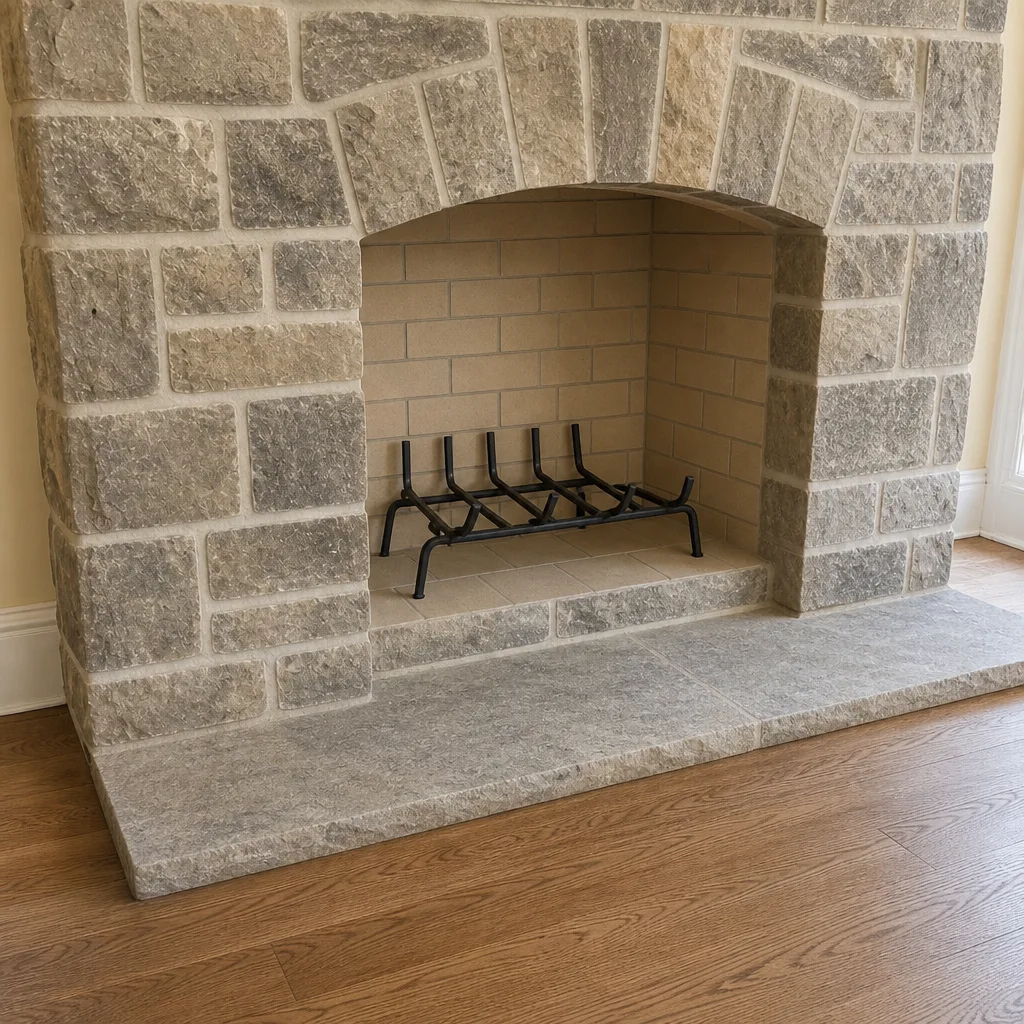
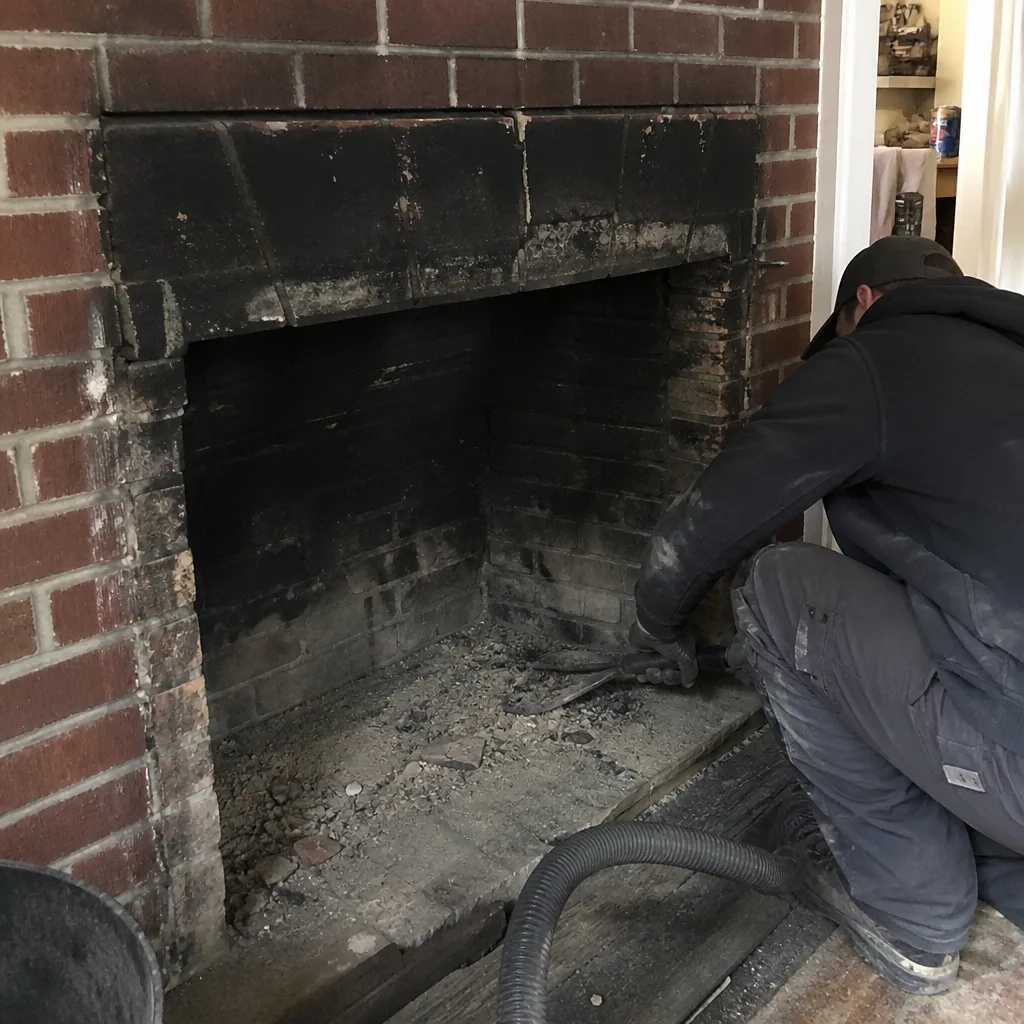
See the difference
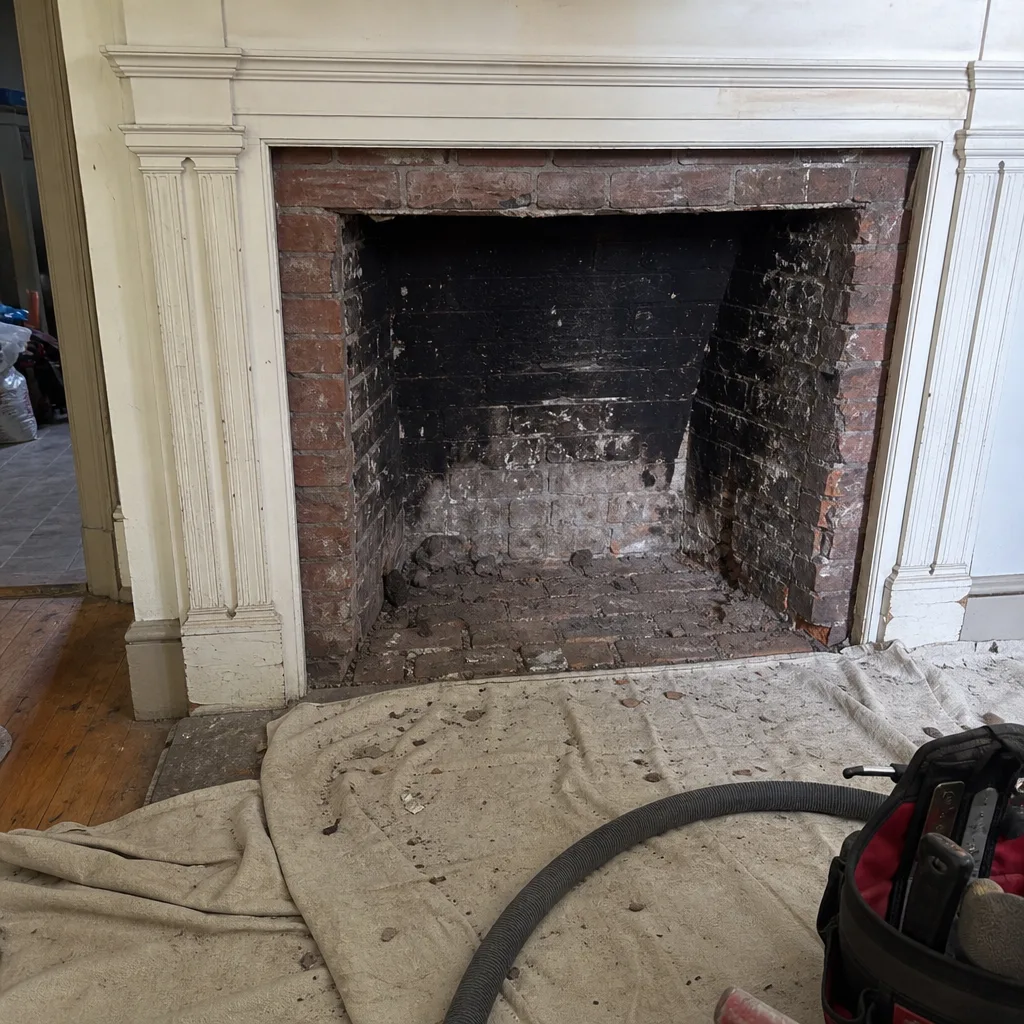 Before
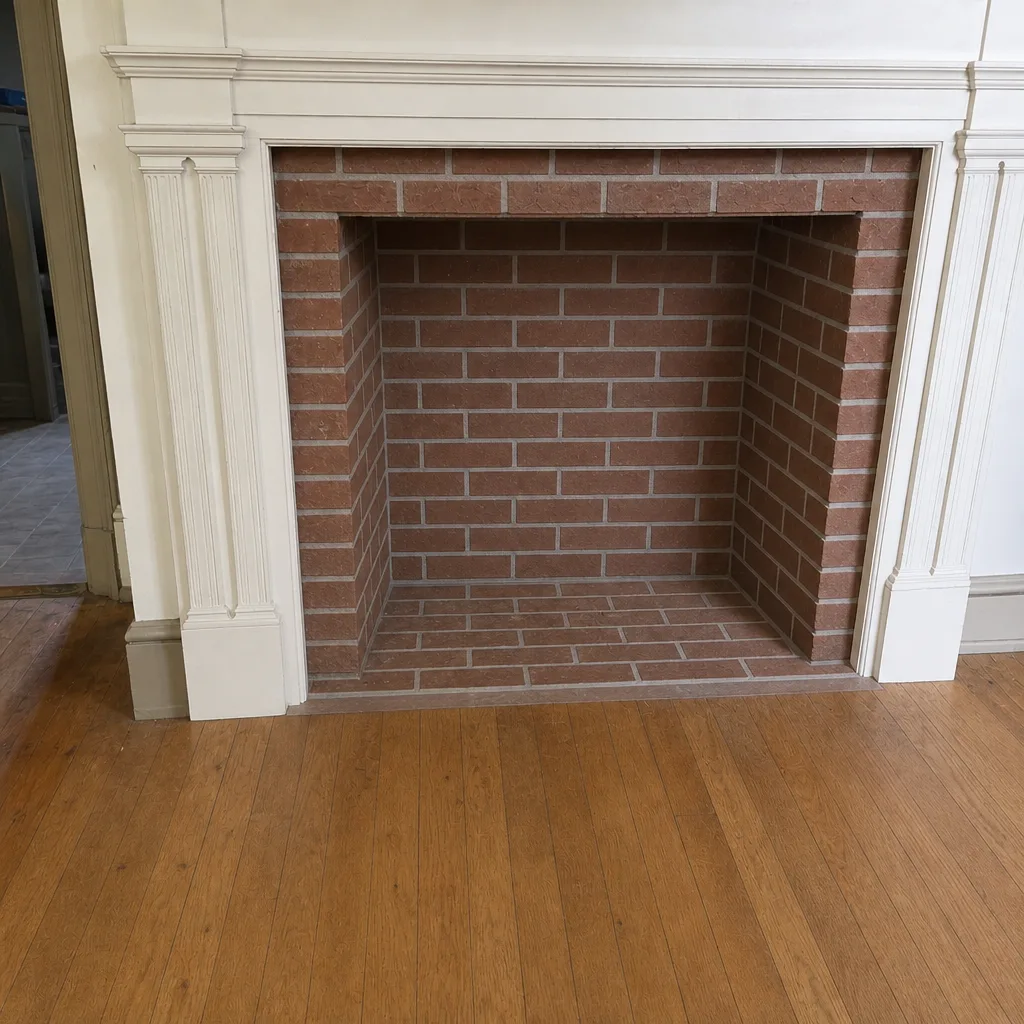 After
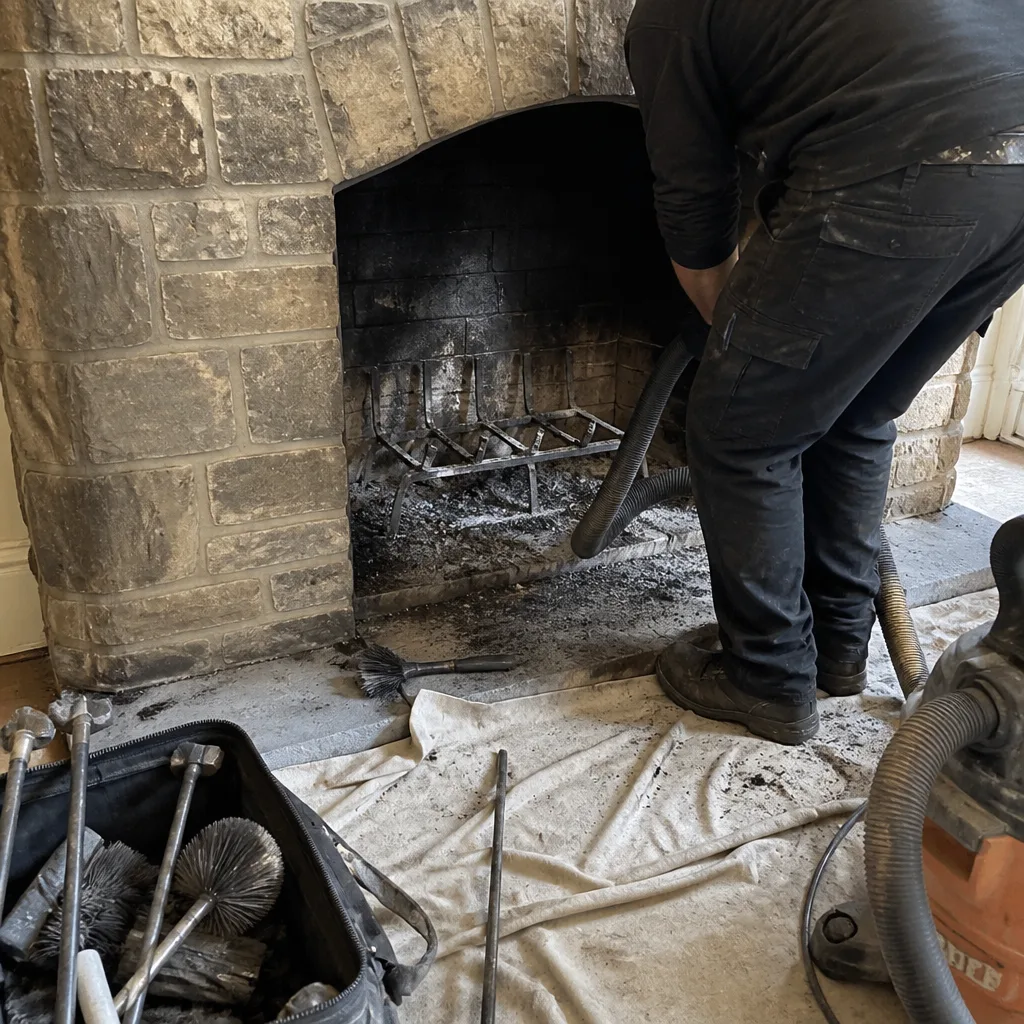 Before
 After
 Before
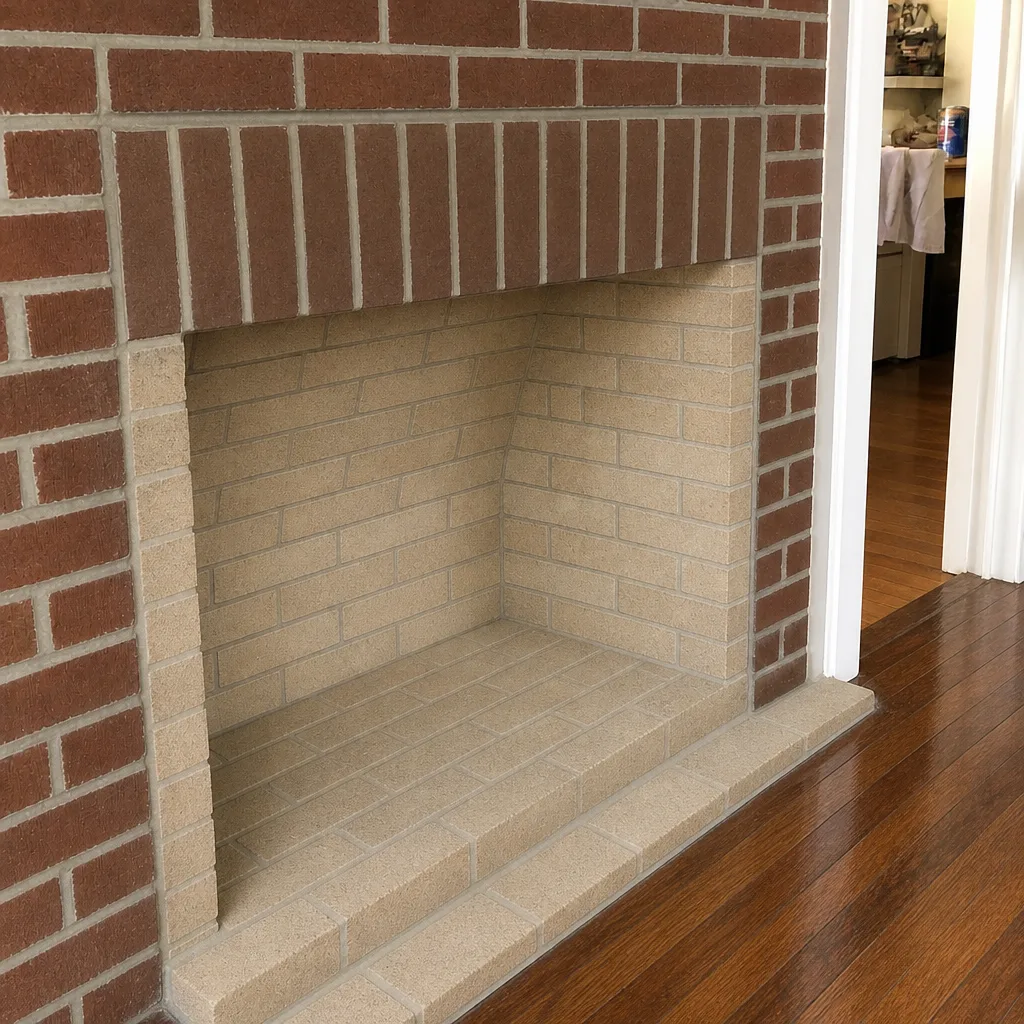 After
When to Call a Professional
There are specific situations where a chimney needs a professional visit rather than a homeowner check. You should call a professional if you haven’t had the chimney inspected since you moved in or in the past twelve months, if you smell smoke in the house when the fireplace is burning, if you notice creosote buildup in the firebox, if the fireplace drafts poorly or smokes into the room, if a wood stove or gas appliance has been added since the chimney was last serviced, or if you can see any deterioration on the crown or cap from the ground. Annual inspection is the baseline for any wood-burning chimney in active use and for any chimney serving a gas or oil appliance. Callers should not attempt to inspect or sweep a flue themselves – the flue is the component that carries carbon monoxide out of the home, and mistakes here aren’t visible until they’re a problem you can’t undo.
Chimney Sweep Elmwood Village offers free estimates in Elmwood Village – call (877) 792-5738. We answer 24/7. Fast dispatch from 7am to 7pm, Sunday through Friday. Closed Saturday.
Frequently Asked Questions
Chimney sweep pricing in Elmwood Village is set per job by a written estimate, and it varies based on the number of flues, the condition of the chimney, whether a camera scan is included, and whether the visit is inspection-only or includes sweeping. The estimate itself is free. Call (877) 792-5738 for an exact quote – estimates are free.
Not always. A camera scan determines whether the liner is actually compromised, and many chimneys don’t need relining at all. When they do, HeatShield ceramic resurfacing can restore a structurally sound flue without full liner replacement, at lower cost and disruption. Nothing is recommended without camera evidence you can see for yourself. Call (877) 792-5738 for an exact quote – estimates are free.
A wood-burning chimney in active use should be inspected annually and swept when the inspection shows enough creosote buildup to warrant it – typically when the buildup reaches an eighth of an inch. Gas and oil appliance chimneys should be inspected annually even though they don’t produce creosote. In Elmwood Village, the practical approach is to have the inspection done before burning season begins in the fall. Call (877) 792-5738 for an exact quote – estimates are free.
Skipping cleaning allows creosote to build up inside the flue. Creosote is combustible, and a hot fire can ignite it. That’s the mechanism behind a chimney fire. Carbon monoxide is the other risk – as a flue liner degrades, exhaust can leak into living space instead of rising out of the chimney. Both risks start in a flue that isn’t visible from the firebox. Call (877) 792-5738 for an exact quote – estimates are free.
They matter because New York State doesn’t license chimney technicians, which means there’s no state-issued credential to verify. CSIA and NFI certifications are third-party credentials with exam requirements and continuing education, and they’re the most reliable signal available in Elmwood Village and across Western New York. Ask which credential a company holds and verify it through the certifying body’s public lookup.
Cleaning and crown repair can be performed in the same service relationship, and we structure our work that way so that a dirty chimney and a damaged crown are addressed together rather than handed off to two different contractors. Whether the actual repair happens the same day depends on the crown condition and materials needed. Call (877) 792-5738 for an exact quote – estimates are free.
The Bottom Line
Hiring a chimney contractor in Elmwood Village comes down to verification, not price. Start by asking which credential the technician holds and confirming it through the certifying body, since New York State doesn’t license this trade. Then ask five questions about scope: camera scan, standalone inspection, in-house liner and crown work, product brands (DuraFlex, HeatShield, Gelco, Olympia Chimney, Famco, and Copperfield are the professional lines), and a written report. Read the estimate line by line and reject bundled pricing. Confirm general liability, E&O, and workers’ comp coverage. Get a scope-of-work document with the technician name, flue description, camera findings, and signed recommendations. Do this once, and the chimney stays a known quantity for years. Do it poorly, and you’re guessing about the component that carries carbon monoxide out of your home.
Chimney Sweep Elmwood Village is a dedicated chimney specialist covering Chimney Sweep, Chimney Repair, Chimney Cap and Crown, Fireplace Repair, and Chimney Inspection – the full system, from inspection through repair. Our technicians have up to 14 years of experience. Reach us at (877) 792-5738 for a free estimate. We answer 24/7. Fast dispatch from 7am to 7pm, Sunday through Friday. Closed Saturday. Written by the team at Chimney Sweep Elmwood Village.
Written by the team at Chimney Sweep Elmwood Village.